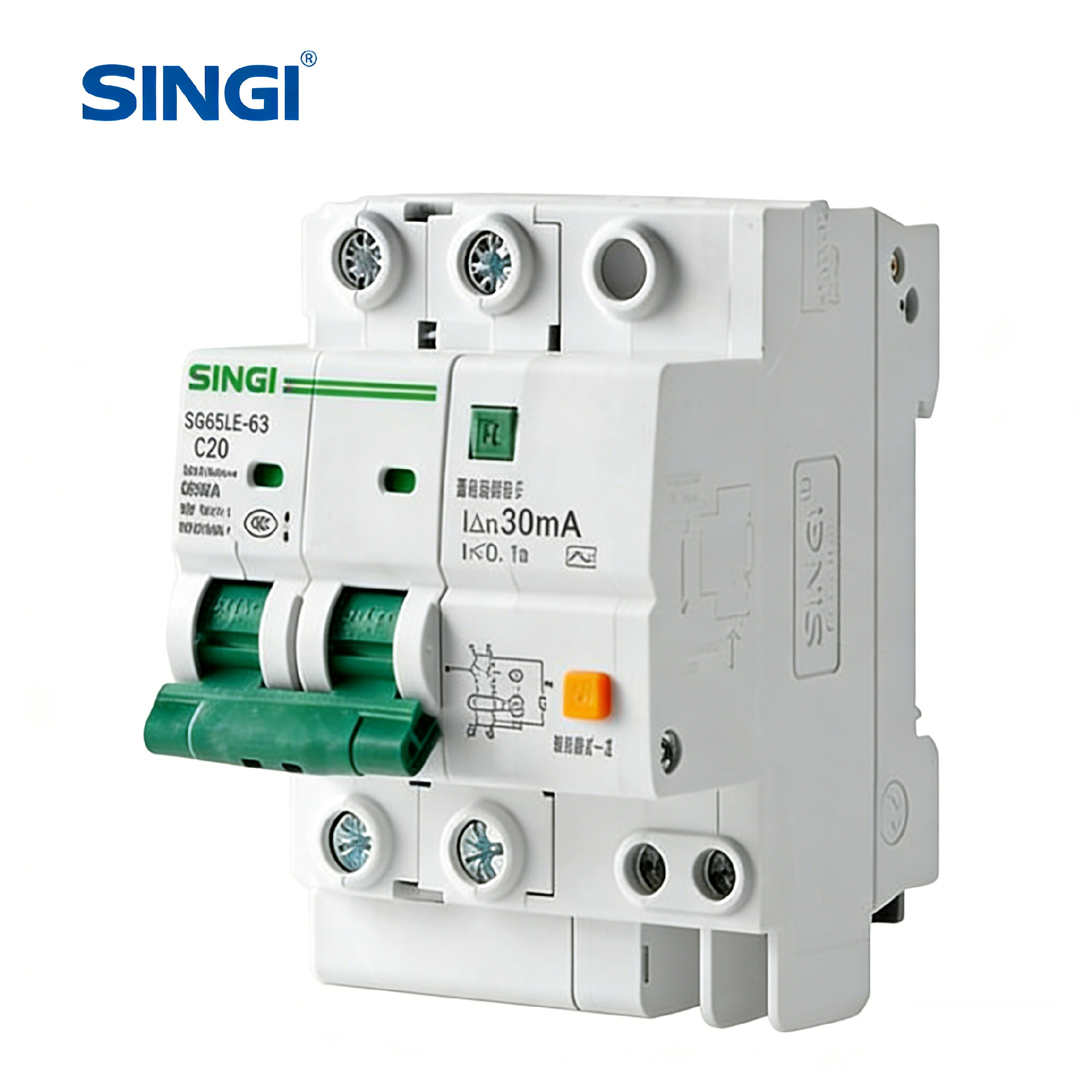
How a Food Processor Cut Electrical Downtime by 90% with the SC65LE-63 RCBO
Customer Background
A regional food processor with 200 employees operates two production lines, cold storage facilities, and a packaging building. The plant runs 16 hours a day, six days a week, producing packaged meat and dairy products for local supermarkets and restaurants. Because of the heavy use of water and steam for cleaning, the facility has a high risk of earth leakage currents. The electrical system also powers several variable speed drives (VSDs) for conveyors and mixers, which add a level of complexity to circuit protection.
Challenges and Pain Points
The plant's original distribution system relied on central residual amperage devices (RCCBs) at each sub-panel, with separate miniature circuit breakers (MCBs) for each outgoing circuit. This configuration caused two persistent problems:
- Whole-zone shutdowns: A single earth fault on any circuit, such as a wet motor cable or a damaged heater element, would trip the central RCCB and cut power to an entire production line. Each trip cost up to 45 minutes of downtime while the maintenance team searched for the faulty circuit and reset the breaker.
- Nuisance tripping: The central RCCB was set at 300 mA to avoid tripping from natural leakage of VSDs and long cable runs. This high threshold meant the system did not provide adequate personal protection for wet areas, and it tripped without warning due to transient leakage spikes from equipment starts.
The maintenance manager reported an average of four unscheduled shutdowns per month, each lasting up to an hour. The lost production time, combined with reset labour and occasional damaged product, cost the company roughly $4,000 per month in unnecessary expenses. In addition, the lack of sensitivity on the RCCB exposed workers to a higher risk of electric shock in the washdown zones.
Why the SC65LE-63 RCBO?
The company assessed two alternative approaches. The first was to install a separate RCCB and MCB for every circuit, which would require a larger panel and major rewiring. The second was to replace the MCBs with higher-quality units and keep the existing central RCCB, but this did not solve the isolation problem.
After comparing several brands of residual amperage circuit breakers with overamperage protection (RCBOs), the team chosen the SINGI SC65LE-63. The decision was based on three critical factors:
- Combined protection in one module: The SC65LE-63 provides both overamperage and earth leakage protection in a single 18 mm wide unit. This allowed the company to replace each MCB with an RCBO without upgrading the distribution board.
- Chooseable residual amperage sensitivity: The product is available with 30 mA and 100 mA sensitivity. The 30 mA units offered true shock protection in washdown areas, while the 100 mA units could be used on VSD circuits to prevent nuisance tripping.
- High breaking capacity and compliance: With a 6 kA breaking capacity, the SC65LE-63 met the plant's short-circuit requirements. It is designed to comply with GB/T 6829-2017 and IEC 60898-1, giving the engineering team confidence in its reliability and performance.
Implementation Process
The project was carried out over a planned two-week maintenance shutdown, with the following key steps:
- Circuit audit: The electrical contractor mapped all 86 final circuits in the plant, recording the type of load, cable length, and typical leakage levels.
- Panel reconfiguration: Each outgoing MCB was removed and replaced with a corresponding SC65LE-63 RCBO. The central RCCBs were left in place as a backup, but set at 300 mA for additional security.
- Circuit testing: Before re-energizing, every circuit was tested with a dedicated insulation resistance tester and a residual amperage test device. This identified weak insulation on two older cable runs that were replaced during the shutdown.
- Commissioning: The plant was energized circuit by circuit, and each RCBO was trip-tested using the integral test button as well as an external RCD tester.
One significant challenge surfaced when the first VSD circuit was energized. The natural leakage from the motor filter caused enough amperage to trip the 30 mA RCBO. The solution was to install 100 mA sensitivity units on the four VSD circuits exclusively, while keeping the 30 mA protection for sockets, lighting, and washdown areas. This compromise maintained personal safety without sacrificing operational reliability.
Quantifiable Results
Over the first six months after the changeover, the facility saw dramatic improvements:
- Unplanned downtime dropped from an average of four hours per month to less than 15 minutes. This represented a 90% reduction in outages caused by earth faults or overloads.
- Electrical maintenance costs fell by $18,000 per year. The reductions came from less troubleshooting labour, fewer emergency call-outs, and a lower incidence of damaged switchgear.
- Product loss due to power interruptions was reduced by 75%. Prior to the upgrade, a single trip could halt pasteurization and cause a batch to be discarded. With circuit-specific RCBOs, only the affected piece of equipment needed to be restarted.
- Worker safety improved . The 30 mA RCBOs on all socket outlets and handwash stations provided a direct level of protection that was missing.
The overall effect was a more resilient electrical infrastructure that supported the plant's goal of reducing production costs and meeting stricter food safety audit requirements.
Client Testimonial
The maintenance manager who led the project noted:
"Switching to the SC65LE-63 RCBOs was the best decision we made for our electrical system. We no longer have to shut down an entire line for one small fault, and the quick-pick visual indication on each unit helps us identify the exact circuit that needs attention. The installation was straightforward, and the product has performed flawlessly."
Lessons and Recommendations
For industrial and commercial facilities that rely on continuous operations, the experience at this food plant offers three practical takeaways:
- Isolate protection at the circuit level. While central RCCBs provide a backstop, they should not be the only residual amperage protection in a modern low-volt-level network. Per-circuit RCBOs, such as the SC65LE-63, limit the blast radius of an electrical fault.
- Measure leakage before choosing sensitivity. Equipment such as VSDs and motors have inherent leakage currents. A proper leakage survey will help determine where 30 mA devices are necessary and where 100 mA devices are more suitable.
- Plan for a structured shutdown during retrofits. Replacing every breaker in a panel is not a task that should be rushed. A designated shutdown window, with careful circuit identification and testing, prevents mistakes and ensures a clean transition.
If the project were repeated, the company would consider adding remote monitoring to the RCBOs and logging fault history in the plant's maintenance software, making the system even more transparent. For other operations with similar challenges, upgrading to a residual amperage circuit breaker with overamperage protection is a proven step toward reducing downtime and enhancing safety.
References
The following standards are relevant to the design, testing, and application of residual amperage circuit breakers with overamperage protection (RCBOs) such as the SC65LE-63:
- GB/T 6829-2017. Residual amperage operated circuit-breakers with or without overamperage protection for household and similar uses (RCBOs) [S]. 2017.
- IEC 60898-1. Electrical accessories — Circuit-breakers for overamperage protection for household and similar installations — Part 1: Circuit-breakers for a.c. Operation [S]. 2019.
- GB/T 10963.1-2020. Electrical accessories — Circuit breakers for overamperage protection for household and similar installations — Part 1: Circuit-breakers for a.c. Operation [S]. 2020.